
Dream State
Encounters in Rajasthan

This piece is the continuation of a story begun here.
I woke to the gentle rocking of the train. Swinging down from my bunk, I proceeded to brush my teeth while sitting in the open door of the car, the ground rushing along inches beneath my feet. Amtrak would never have allowed this, but I had already learned that the norms bracketing my 21st-century American existence did not obtain in this place.
When planning my trip I had considered many possible routes. I had toyed with visiting the beaches of Goa. I had read up on the snowy fastnesses of Kashmir. I had even researched how to book passage from Tamil Nadu to Sri Lanka. But then I learned about the remote cities of Rajasthan, with their rat palaces and Thousand And One Nights glamour, and decided to start there.
The undulating desert was dry but not entirely desolate, dotted here and there with stoic trees. This was not a terrain of dunes, but of camel-colored dirt, pink rock, and achingly blue sky. Humped cattle ambled through trackside swales. Peacocks sat atop fence posts. The very air seemed to phosphoresce with a hot white brilliance. We arrived in Jaipur as dusk was settling over the ancient city. The train’s cowcatcher forced a troop of monkeys from the tracks, sending them howling into the gloam.
At dawn the following day a rickshaw driver dropped me at the edge of the city, where a towering gateway of red stone stood near the foot of a hill. Traffic broke against the portal’s bulk like surf, but as I passed through its central archway the noise and chaos fell away with uncanny swiftness. Just ahead of me, a trickle of people were starting up a serpentine path. I fell in behind them.
I had only been climbing for a couple minutes when the sound of male voices came floating on the breeze. They were chanting in call and response, one voice shouting a word, the others echoing in unison. On the ride across town I had passed groups of men and boys decked out in bright orange garb. When the chanters swung into view above me I saw they were clad in the same orange garments, and realized the intermittent parade slowly processing through the city must originate somewhere on the very hill I was climbing. Most of the group were young, in their teens or early twenties, with the odd young boy or middle-aged uncle thrown in. As they drew near I stood aside to let them pass.
At their head walked a standard-bearer carrying a pole from which flew an enormous triangular flag hung with tassels and bearing five bold stripes. As the marchers passed by I took in their patchwork outfits. Dark mango board shorts and tangerine t-shirts; flowing linen pants of melon hue that wrapped around legs and hips in a conflagration of knots; neon orange bandanas. Many had applied patterns of saffron-colored mud to their foreheads. Every one of them had coal black hair, and carried a yoke across his shoulders, from the ends of which dangled containers of what I later learned was holy water drawn from a pool at the top of the hill.
I did not yet know that these men were headed for an altar where they would pour out their water in tribute to a Hindu deity. I did not know what the words they were chanting meant. But as I stood on the flagstone path, their voices ringing in the morning air, something clenched in my chest. The boys waved to me happily, their eyes shining as they gave me a big thumbs up or chirped “Hey bay-bee!” in their best American accents. I waved back, ambushed by the tears rolling down my cheeks.
As the procession receded downhill I continued to climb. Soon I reached a small colonnade wherein lounged a family of languorous, blank-faced monkeys. Except for their brethren on the railroad tracks the day before, I had never seen a monkey outside of a zoo. Primates are easy to anthropomorphize, and this group seemed to project a distinctly human air of laziness. The males stared me down, unapologetic, unafraid, their massive testicles resting on the ground before them. It has been said that every living being is God’s love made visible. That’s a beautiful sentiment, but one which my time in India tested. How might a disdainful camel embody the love of the divine? What about the radical horniness of a back alley dog, or the bleeding body of a fatally wounded bat? Perhaps what we feel when we see a golden retriever puppy, or a beautiful stallion in mid-stride, is a reaction to but a narrow band of that light which illuminates the filament of the world.
I pressed on to the top of the ridge, where I removed my shoes in obedience to a posted sign before slipping through a wooden gate into the grounds of a shrine. A man was just walking up the steps of the central enclosure. He grasped a hanging bell and clanged it once before sitting down cross-legged before an idol, or murti. A cluster of women sat chatting on some nearby steps while a toddler wandered the rampart that defined the shrine’s perimeter. I walked over toward him to take in the view. The cityscape below was blurry through the dust and heat. The boy was running his hand along the stone, babbling happily to himself. He could not have been more than two years old.
Looking out over Jaipur above the head of this little child, whose father was currently prostrating himself before an idol, I was struck by a simple fact I had considered many times before, though never under these circumstances; that untold millions of children around the world had not only never heard the Christian story which was central to my life — and as a result never had a chance to reflect upon, ignore, reject, or embrace it — but had come of age actively imbibing an alternate explanation of reality. They were as steeped in the waters of their own faith as I was in mine.
I gazed at the young boy, now gleefully picking his nose. In a few years, he might carry his own yoke of water down the hill. I didn’t think about cosmic justice in that moment, or how a loving God could hold this young boy culpable for revering the deities who, as far as he had been taught, ruled the cosmos. I did not venture into the borderland between physics and metaphysics where I might have speculated about the possibility of believing in something you’ve never heard of, or the age at which a toddler’s soul unknowingly wanders from a state of innocence out onto the terrifying ledge of accountability. I just closed my eyes and listened to the murmur of the women on the steps.
The winding path descended the back slope of the ridge, leveling off at a pen where burros rolled in the dust. A few yards away a pool had been carved from the rock. It was full of turbid green water dotted with floating garbage. Yet more orange-clad young men were gathered in the shade of the cliffs which hemmed the pool, busily daubing their faces with paint and filling their jars in preparation for their own march into the city.
A group of young women looked on beside me. One of them was strikingly beautiful. She must have been 18 or 19 years old, and was wearing a bright blue sari decorated with a repeating design of silver emblems. Her dark hair was pulled back in a ponytail. Large earrings hung from her delicate earlobes. She had a pensive look on her face. I wondered what life was like for a beautiful young woman in Jaipur. I wondered what she thought of what I perceived to be the filth surrounding us, whether she was bothered by the garbage and the flies and the blowing plastic bags.
At length I clambered back over the ridge. Returning by a different path this time, I passed a row of low-slung buildings in front of which a group of robed and bearded sadhus sat talking. One of them, with his thick glasses and balding pate, looked like the twin of Allen Ginsberg. Opposite the holy men stood a staircase leading up to a doorway. I climbed the stairs and looked inside. The door opened onto a room in which a man sat cross-legged before a group of life-sized human figures dressed in intricate robes. Alien music blared from hidden speakers.
The statues had faces of white china. Something about them made the hair stand up on the back of my neck. The attendant motioned for me to enter, gesturing toward the ground directly in front of the idols. He seemed to be inviting me to bow down, or perhaps just to come further in. I shook my head. Colorful posters of Krishna and the Hindu pantheon covered the walls, many of them yellowed and peeling from the plaster. The seated man pointed again. This time I said “no” out loud, and retreated down the steps.
The following morning I spent an hour sitting across from the entrance to Jaipur’s Hawa Mahal, the Palace of Winds. The palace itself was beautiful, but the thing that held me rapt was a small sidewalk shrine containing an idol of Ganesha. Beside the shrine’s grate hung a colorful poster of Kali, consort of Shiva. It was a traditional image, in which two of Kali’s four arms hold a scythe and a trident. A garland of severed heads bounces on her chest as she dances across a battlefield, drunk on the blood of the demon Raktabija whom she has just slain. A steady stream of morning commuters was walking past the shrine. Many stopped, stepping out of their sandals and pressing their palms together before bowing in the dirt. A few kissed the metal grille behind which the idol sat before continuing on their way.
As I watched the men of Jaipur halt in the middle of a busy street to bow before an altar decorated with a picture of a god holding a severed head, a feeling I could not fully parse stole over me, part sorrow, part disjointed sense of exposure to pure otherness. The worshippers’ lack of inhibition moved me, even while I felt something ominous pressing against my ribs, a foreboding that stemmed not from the sincerity of the devotion on display but from its object.
Prior to that time, I had only ever considered idols in the context of the Old Testament. The Jewish prophets recount the seemingly interminable story of the campaign God wages for the hearts of a people prone to placing their hope in lifeless objects rather than in the Giver of Life. I was well steeped in their literature, with its stories of golden calves and Asherah poles and pagan prophets cutting themselves with knives while screaming for their gods to wake up. But I had been raised in churches where the language of idolatry was only ever employed as a metaphor for those things modern Americans are prone to pursue in lieu of God, be it wealth, power, sex, or possessions. Now here was the genuine article, and I was startled and disturbed.
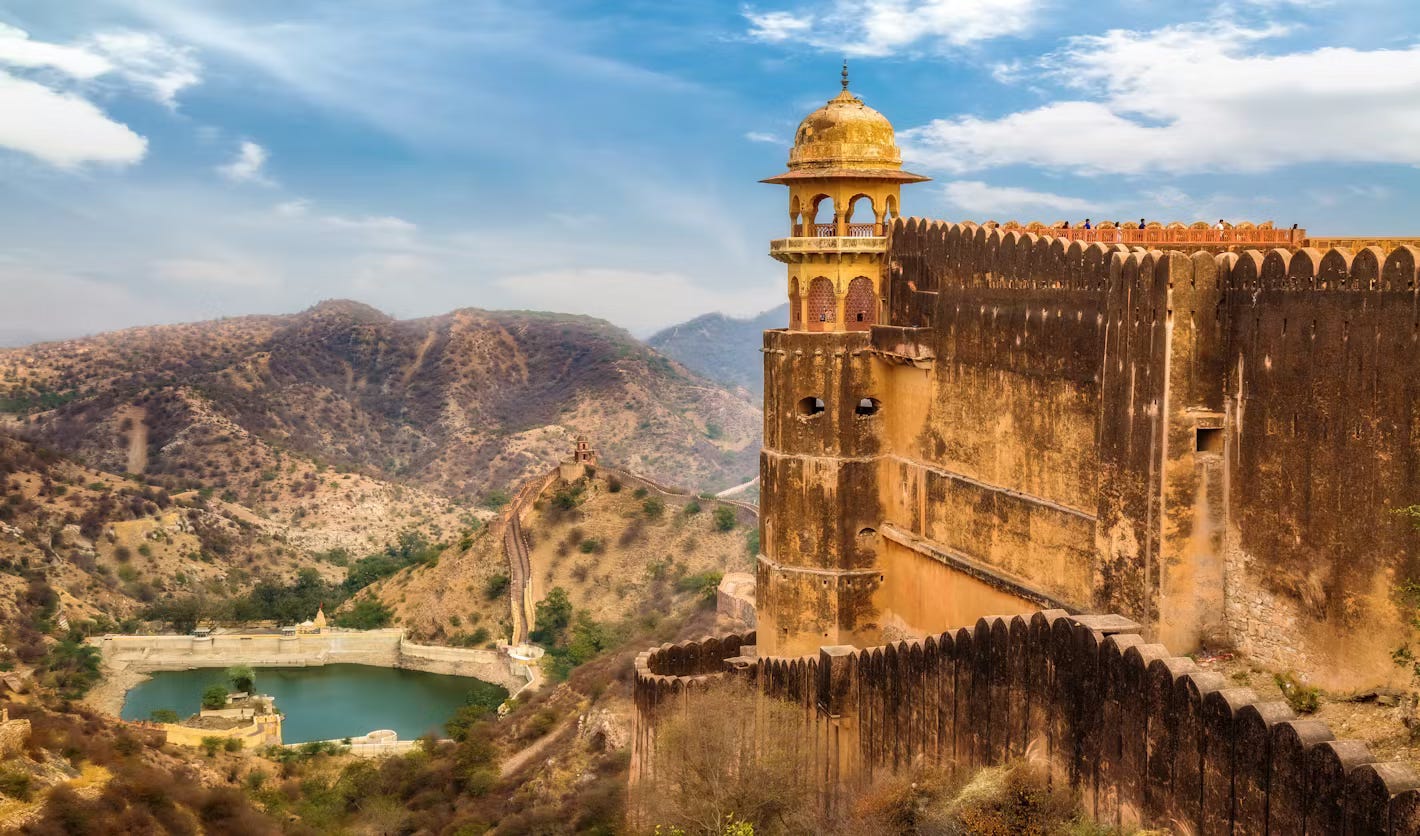
The town of Bundi feels medieval. Narrow lanes meander and curve amidst buildings painted a ghostly blue. An old stone fort with crenellated battlements clings to the side of a rocky hill above town. At night its ancient stones are lit up like a fairytale.
I had arrived via a four-hour bus ride from Jaipur. It was late afternoon, and sunlight was falling across the mouths of alleys in golden slabs. I wandered through the maze of streets alongside milky white cows. At some point I found myself climbing. Soon after passing the fort’s looming turrets the twisting pavement petered out into a dirt trail. I had been following this trail in silence for a few minutes when a crashing sound came from the undergrowth ahead accompanied by intimidating shrieks. I was about to turn back when two men came up the trail behind me.
The fellow in front wore a length of red cloth wrapped around his waist and a white undershirt that contrasted with his mahogany skin. A scraggly beard clung to his jaw. His companion was tall and clean-shaven. The bearded man greeted me in English.
“My name is Viver,” he said. “We’re on our way to the top. You can come with us.”
My ambivalence must have been obvious.
“We’ve been going every day for a month,” Viver went on. “It’s the time of a festival to Shiva.”
The heat was sapping my energy and I was leery of the monkeys.
“We are going to pray,” Viver explained. “You can come if you want.”
“I don’t want to pray,” I said. The words sounded unnecessarily abrupt. I wondered if I had given offense, but Viver only smiled.
“You do not have to pray,” he said. “Just come watch.”
With that he turned and continued uphill, his friend trudging behind. My curiosity got the better of me.
The shrine had a half-finished air, consisting of nothing but a concrete slab and a roof held up by a few rough supports. Bundi spread out below us. Beyond the edge of town the desert rolled in waves. The sun was falling in the west.
Upon arrival, Viver lit a stick of incense and placed it in a nook above a small alcove holding a murti. Then he stepped back and began to sing. His voice was rich and sonorous. He clapped as he sang, twirling his hands with a flourish between beats. The melody was simple, almost childlike, alternately climbing and descending again. After finishing his song, Viver gathered incense and flowers and moved to the certain of the shrine where a lingam — that phallic column of stone used in temple worship throughout India — protruded from the floor. He motioned for his companion to join him. Together they sprinkled pink and magenta petals on the lingam before Viver concluded their offerings by pouring something thick from a jar onto the squat pillar’s surface. As the liquid oozed down the sides of the stone both men lay facedown before it.
The sun was setting in earnest now, turning the scattered clouds into vast reefs of coral. The howls of the monkeys had faded, and the breeze riffling the underbrush was the only sound beside the murmuring of prayers. I had remained just outside the shrine, watching quietly. Now the men rose and moved to a side altar featuring a representation of Ganesha, where they lit a last stick of incense and took up their hymn again. I looked at the elephant-headed god. If the position of his limbs or the crown on his head conveyed a symbolic message, it was lost on me. I listened in rapt silence to the conclusion of the song.
Ek dant dayavant, char bhuja dhari
Mathe par tilak sohe, muse ki savari
Pan chadhe, phul chadhe, aur chadhe meva
Ladduan ka bhog lage, sant kare seva.
O Lord of compassion, you bear a single tusk, four arms,
A vermilion mark upon your forehead, and ride on a mouse.
People offer you betel leaves, blossoms, fruits
And sweets, while saints and seers worship You.
When I think back on those days, I wonder what has become of the young men I encountered in the Rajasthani desert, singing their songs of devotion. Have they gone to university or gotten married? Have they become bricklayers, or died of disease, or moved to England? Do they still bow before their idols each year on the night before Raksha Bandhan?
Wherever they are I have not forgotten them, those angels of the throng. Even now I can close my eyes and see their faces, shining before the face of God.
This story continues here.