
Full of Grace
Considering the Annunciation as a parent

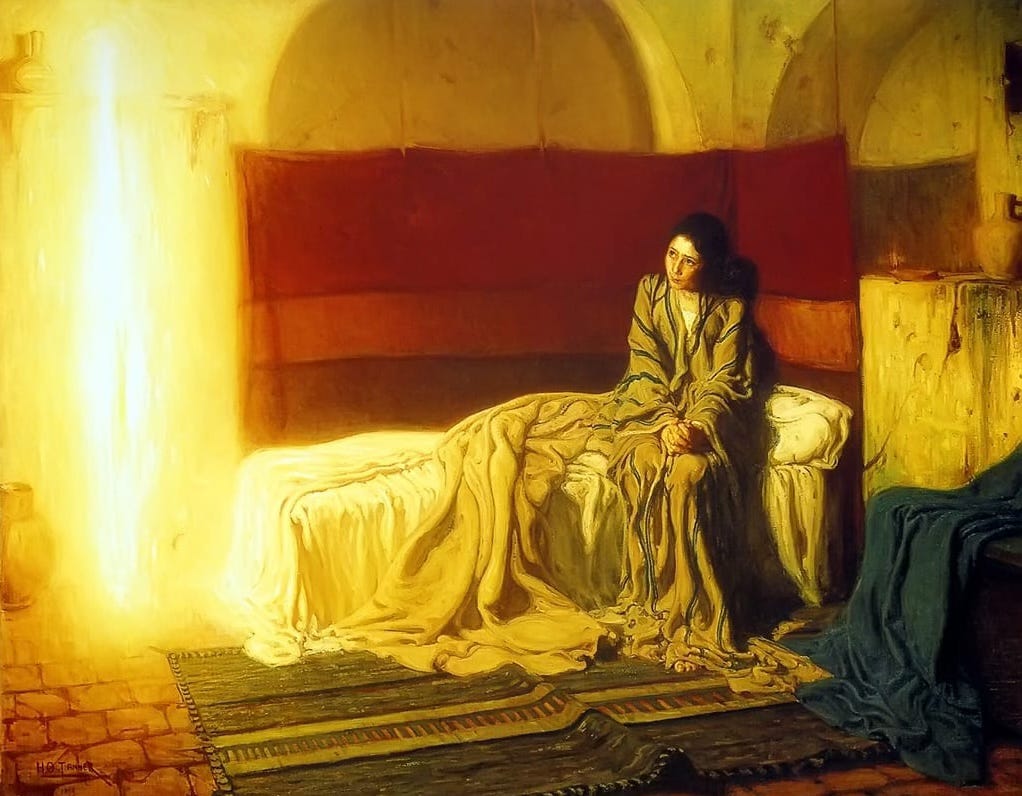
Today is the Feast of the Annunciation, when Christians contemplate the story of the angel Gabriel’s appearance to a poor young woman in a backwater town, bearing the news that she was to become the mother of the son of God. The proximity of this holy day to Easter, the greatest of all feasts, strikes me as newly poignant this year. These twin commemorations, marking epochal events in human history, also mark two specific moments in the life of this particular woman; that of her imminent conception and, years later, the violent end of her as-yet-unborn child’s life.
My own journey as a parent has been fraught with pain. It can feel like the only way to acknowledge this in polite company is to leaven my testimony with humor, but while I have found much joy in being with my young children, as well as a bottomless aquifer of love and a great sense of meaning, the unvarnished truth is that much of my lived experience of fatherhood has involved suffering. My own specific anxieties, insecurities, and failures have commingled with the distinct personalities and needs of my son and daughter in a way that has often proved deeply distressing to me.
To become a parent is to pierce a veil of ignorance. Prior to the birth of my eldest child I was oblivious to what his needs would entail, and how utterly my life would change with his arrival. In this regard I have come to feel a solidarity with Mary, who would have also been ignorant of the many ways her own life was about to be upended as she listened to the archangel’s heart-stopping prophecy.
The Bible offers few, if any, unambiguously heroic figures. I recently re-read Genesis, and was horrified afresh at the murder and lies and cowardice and dissembling and manipulations engaged in by the inaugural figures of the Hebrew covenant. There is much to be said about how the profound imperfections, even outright evil, that marked the lives of the patriarchs provide a window onto the grace of God, but I certainly do not aspire to be like Abraham, or Isaac, or Jacob, or Joshua, or David. I take some comfort in the comic fallibility of the apostles, but I don’t otherwise feel much resonance with them as people. I don’t know that I have ever wanted to be like anyone in the Bible other than Christ, and his call often leaves me with a sense of standing at the bottom of a towering mountain I cannot reasonably expect to climb. He is so radical, so difficult, so wonderful, while I am just a man.
Mary is different. As a boy, my conception of her was largely based on Luke’s Christmas narrative. She was referenced with respect and admiration in our nondenominational evangelical church, but kept at arm’s length the rest of the year. I suspect the adults in my orbit weren’t quite sure what to do with Mary; the Catholics seemed to worship her, and that was alarming, so at the end of December we would wrap her up and put her back in the box with all the other ornaments until the following year.
Eventually I grew up, moved out, and commenced a decades-long ramble through various arms of the church, where I began encountering Mary from different angles. Now, as a middle-aged parent, I find that there is something about her youth and vulnerability at that moment when she was first thrust into events beyond her ability to control which gives me hope. I hold no illusions as to her perfection, in motherhood or anything else. Long years of her life are hidden, including most of Jesus’s childhood. Yet the glimpses I catch of her in Scripture leave me with the sense of someone who displayed a simple, earnest humility before God amidst the crucible of parenthood, and was then faithful to her child unto the very end of a dark road on which she had not asked to walk.
The ideal of the good parent is central to how Christians throughout the ages have conceived of the One whom Jesus called his heavenly Father, but our lived experience as human beings is infinitely closer to that of Jesus’s earthly parents. We are not gods. We are finite, imperfect, fraying, non-omniscient. Mary was all these things, too. (Joseph, whose sacrifices were also profound, is worthy of his own reflection, but it is Mary I meditate on today.) She would have known the frustrations of the endless demands young children make, and the difficulty of meeting those demands while also laboring to make ends meet. She was in a marriage. She had her own hopes and dreams, surely. She had a mortal body that grew tired, and aged, and developed nagging pains. Maybe she hated camels. Maybe she loved figs.
She also had to deal with things most parents don’t, including the challenge of trying to understand her son’s portentous fate, how to support him through the emergence of his strange, counterintuitive ministry, and how to navigate the admixture of adulation and infamy that eventually followed him wherever he went. Yes, she was that Jesus’s mother.
As I have said, I did not know what I was getting into when my wife and I began trying to conceive a child, but no one came to me and declared that I would become a parent. Mary was simply told this would be happening, and by an otherworldly being. We cannot know if she considered, in that moment, the painful ways in which becoming pregnant out of wedlock might play out for her, or what motherhood would entail more generally. Maybe she didn’t feel ready to become a mother at all. Maybe she was overjoyed, or bewildered, or numbly terrified by this creature of searing light, who tore open space-time to step into a dusty Galilean morning and speak with her. We don’t know, just as we cannot know what God would have done if she had resisted. We know only that she did not, declaring, “I am the Lord’s servant. May it be to me as you have said.”
This phrasing of her consent in the text — “May it be to me as you have said” — prefigures another famous statement, made by her son when he was about to die.
Not my will, but yours be done.
This acquiescence to the dark waters of God’s purposes is not my style. I have raged, often and with great emotion, against my circumstances as a parent. I constantly fail to submit to the facts of my life, and to the needs of my wife and children as realities that are bound up with the will of God. Instead I complain, and pout, and rail, and sometimes even indulge despair. Mary seems not to have done this, though there is no reason to think she did not have her own dark nights. We know that she endured the difficult circumstances of her pregnancy, and that when the time came she held her infant son and wrapped his bloody, wrinkled body with clean cloth. Over the coming years she would hold him when he was sick in the middle of the night, and comfort him when he skinned his knee, and dry his tears when a playmate was unkind to him. A day would come when she would hug him with delight at a wedding, after he had finally revealed to his nascent band of followers what she had known all along. And then another day, when she would be left holding her baby’s body one last time after it was brought down from the cross, torn and mutilated and limp.
We often say that we “cannot imagine” some horrible thing, when what we really mean is that we have already imagined it, and the reality in question seems so terrifying, so laden with trauma, that even the act of imagining is itself unbearable. I picture Mary sitting on the ground, rocking the body of the one who would always remain her little boy, and I feel horror. This woman, who had cooperated with and blessed God despite the hardships of the life set before her was left to weep, inconsolable, beneath the indifferent gaze of the soldiers who had just killed her child.
That moment is not the end of the story we Christians have carried through the centuries, but it is worth staying with for a moment. For just as we believe that Christ’s agony in death was not relieved by the hope of his resurrection, we also affirm the totality of his mother’s desolation in the hour of her bereavement.
The gospels do not record the moment of Mary’s reunion with Jesus after his resurrection. When she first heard a report that he was alive, did she believe it? Did she weep at the cruelty of this impossible hope? When the moment did come, when she saw the wounds in the hands she had once clasped in her own as she walked with her toddler through the market on some long-ago morning, what did she feel?
Perhaps that moment was not recorded by the authors of the Gospels for a reason. Maybe no one else was there. Maybe that was the ultimate moment which Mary “treasured up in her heart,” never to be shared with anyone else. Perhaps the son came to his mother when she was alone on purpose, with words and an embrace that were only for her.
When I remember Mary today, this obscure teenager who would become the most revered woman in human history, I think of all the boredom she must have suffered, all the grating need that she, like all mothers, would have absorbed, from her other children, yes, but also from the young Savior himself. I think of all the mundane weeks and trying hours she spent raising him to adulthood, and the little, exquisite moments of joy she would have felt at his silly faces and new discoveries and first words and loose teeth. I think too of that incomparable joy she tasted in the consummation of her son’s victory over all forms of sorrow, both the banal and the virulently evil, when he returned to her from the grave. And in this contemplation, amidst my own lack and sorrows, I feel comforted.